

Loss: necessary or just inevitable?
And does it matter? Revisiting the wisdom of Judith Viorst
Before we begin
What has loss taught you or given to you?
Welcome! You’ve reached Spark. Learn more here or just read on. If you received this from a friend, please join us by subscribing. It’s free! All you have to do is press the button below
I arrived home late Sunday evening after 12 days of traveling over geographic and emotional terrain that took me to every corner of my soul and asked a lot of my body. At every turn, I was faced with the reality and inevitability of loss. At every turn, I was challenged to find the deep joy that was available all around me, often inextricably twined with those losses. I have been trying to put myself back together ever since returning. I have the help of a partner who understands everything and made a vat of his magic soup, and two dogs who understand nothing except that the pack is once again whole.
I am not yet whole however. It’s not the cold I caught on the plane home, or the fatigue - although they probably contribute – it’s the realization that even when I know that nothing stays the same, particularly at this stage of life, I still struggle against loss. This is not a new struggle and one that will probably continue the rest of my life. I know by now that I will emerge from this with something I didn’t have before. I cling to that. In fact, I have proof. I’ve written about this before along with a book that has helped me to navigate change and loss in the past. Both seem relevant now so I share once again some writing from a couple of years ago that seems relevant once again.
Lost, Then Found
“It is the image in the mind that binds us to our lost treasures, but it is the loss that shapes the image.” —Colette
My friend has lost a word. It was right there a moment ago, or was it? Anyway, she knows there is a word for the animals that she is taking care of outside in a little structure with wire around it. She calls them critters for now. It’s not important to me what she calls them. She still remembers me when we talk on the phone from our homes separated by nearly 3,000 miles. She still remembers some moments we shared when we were ten, eleven, twelve. She gets angry when her brain refuses to do what she wants it to but more often, lately, it seems she is more focused on the critters and the joy they give her. She is finding her way through the days – it is up to me to find a way to accept her changes instead of longing for the easy confidences, the way we were before dementia began to change her.
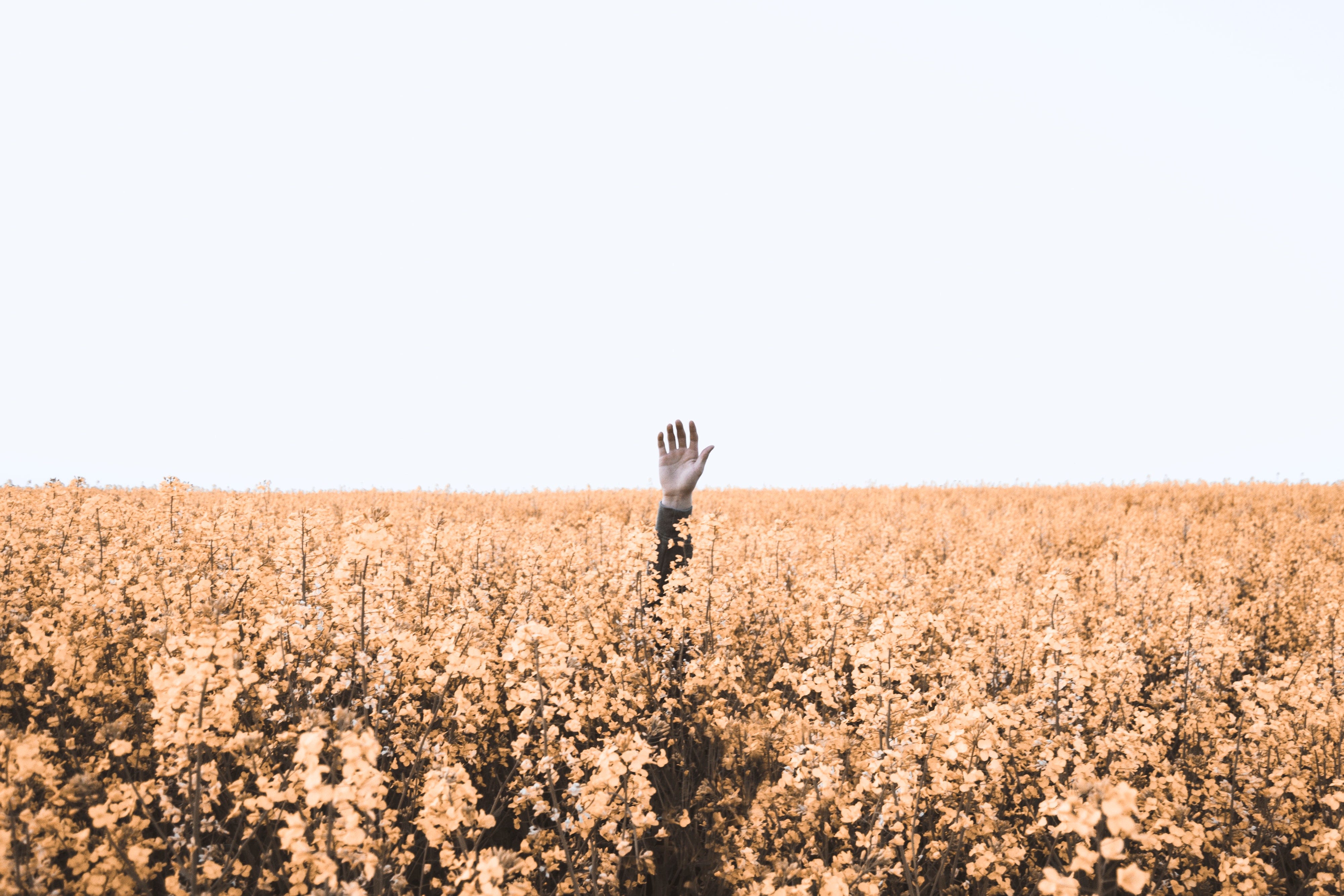
Another voice. Another loved one. I’m a little lost, he said. It was the voice of a person I love deeply, another person who does not live close to me, a person I think about every day. That catch of sadness and surprise -- to find himself lost at a time when he’d hoped, perhaps even expected, to have landed in middle-age with a sense of achievement. He is still haunted by the notion that there is a destination of sorts, that is possible to reach a goal and rest. He is in the process of losing this notion, I think. I hope he finds a way to let it go, not that I have done such a great job of that myself.
I hang on to notions. I hang on to people. I hang on to things. I hate the powerlessness I feel when they are stripped away from me.
I hang on to notions. I hang on to people. I hang on to things. I hate the powerlessness I feel when they are stripped away from me. I am thinking right now of Mr. S, the elderly father of my old landlord back in New Jersey. He lived in the apartment below me in an old two-family house with his wife who’d had a serious stroke and couldn’t communicate with him. Bored out of his mind and struggling to find his own sense of purpose, he took interest in my life and my apartment. He would empty my garbage for me even though I asked him not to come into my apartment when I was away. He would check the plumbing, invent reasons to “take care of me.”
One weekend, I retrieved a box in the garage that contained old photos and everything I’d written in college: journals, letters, stories, and essays. They were mildewed from years of being packed away but I spent an entire Saturday afternoon going through them and rekindling my acquaintance with myself. I found a few pieces with ideas for essays or stories that I wanted to try to rewrite, from a new perspective. I felt the tingling that comes with a new beginning, a chance to start over.
When I was through, I found a plastic bag and put them all in it so the mildew wouldn’t contaminate the inside of my apartment. I left the bag on the kitchen table which doubled as my desk. When I came home from work on Monday, the bag was gone.
Mr. S. had taken the entire bag and emptied it into the recycling bin which had been picked up that morning and emptied. Every page had been fed into the maw of the Somerville, N.J. waste management operation. The helpless rage I felt returned to me for years. I could see the stubborn, uncomprehending gaze of Mr. S. as I teared up and shouted. I told him - told the whole neighborhood - that he had no business even throwing away my garbage, never mind a few years of my life. Shouting didn’t help. There was no way to get them back, or, I was convinced, regain that tingle of hope and confidence I had lost in the years since college.
I was convinced that those moldy pages were my foundation. They bore the encouraging comments of people I respected. They were proof that the writer in me had existed. Without them, I had nothing but a blank canvas and zero faith that I could fill it. I failed to begin again for a long time. Part of me blamed Mr. S. Most of me blamed myself – for not insisting on a lock change, for not putting the papers in another place, for letting it matter so much.
It was a while before I realized that my anger about losing the early writings was a way of clinging to them and to the notion that I’d lost the years they represented. As long as I was angry about it, I didn’t have to face two simple facts: those years were over anyway and nothing was stopping me from starting again except my own fears. It was a while before I found my way again but I did find it.
After I cooled down, I discovered that the upstairs apartment, where I lived, still felt like home to Mr. S. who, because of circumstances and practicalities, had made the house into two apartments. He could not let go of the idea that the house, and everyone in it, were still his responsibility. He kept going back up to my apartment to touch base with the life he’d had, the life he still wanted, the part of his life that was lost to him. He’d lost his wife as she’d been, then his house, then his sense of purpose.
Of the two of us, I gained the most when he threw out those papers.
Judith Viorst: what we must give up in order to grow
“There comes a time when we aren't allowed not to know.” ― Judith Viorst, Necessary Losses: The Loves, Illusions, Dependencies, and Impossible Expectations That All of Us Have to Give Up In Order to Grow
I’ve been thinking about Judith Viorst’s book Necessary Losses, a book that I read without the slightest comprehension when it came out in 1986 but resonates deeply with me now. I’ve drawn on it for research but also because it is a joy to read. It’s based on the “the vital bond between our losses and our gains…what we give up in order to grow.”
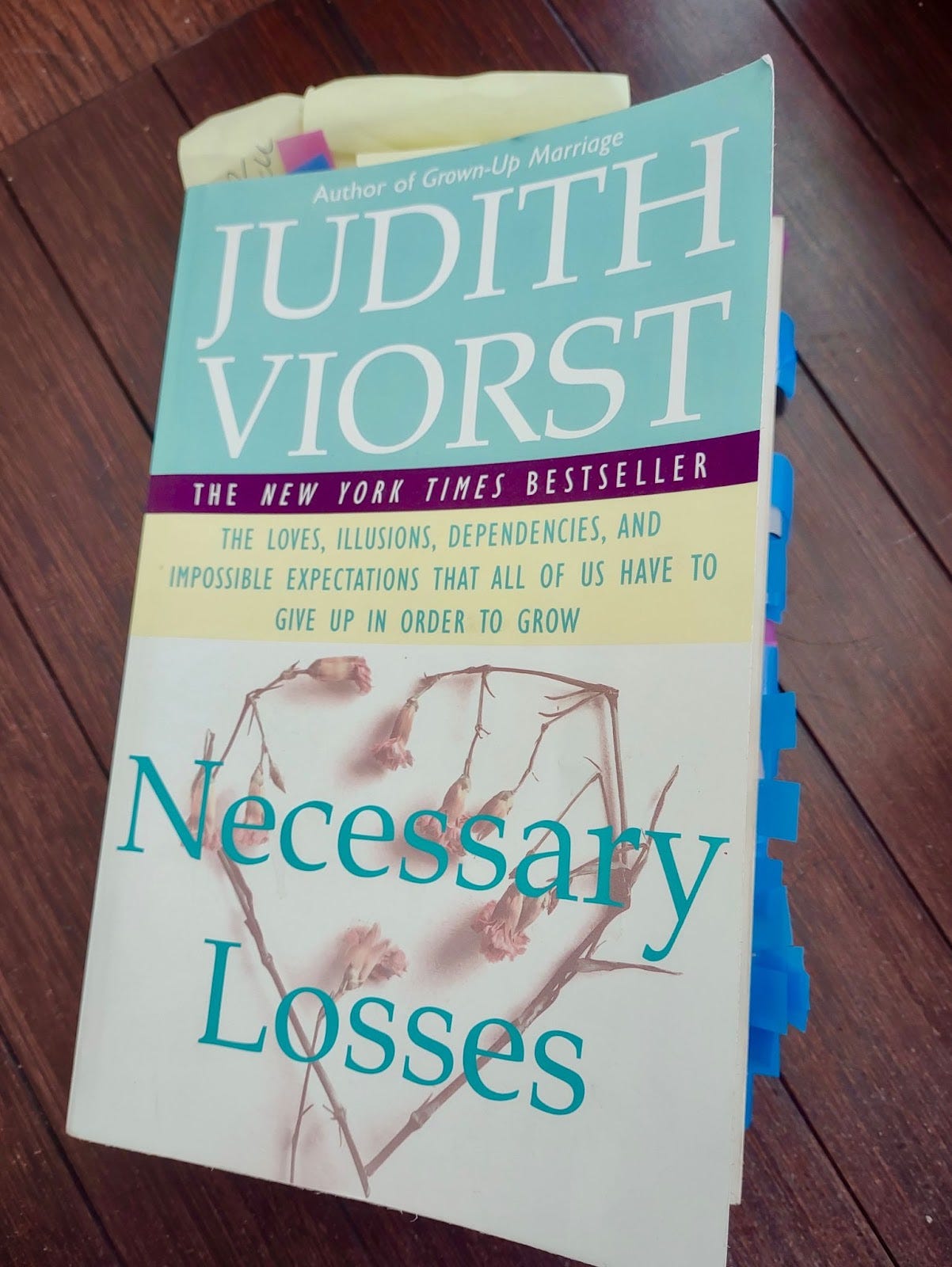
A poet, a syndicated columnist, writer of children’s books and nonfiction for adults, Viorst also studied psychoanalysis for six years. This last informs her book, Necessary Losses: The Loves, Illusions, Dependencies, and Impossible Expectations That All of Us Have to Give Up In Order to Grow but her trademark grace, thoughtfulness, and humor can be found throughout its pages.
If you are in the mood to remind yourself of all the very rational reasons we react to loss in so many different and often contradictory ways, pick up a copy of this book and leave it where you can reach for it. It reminds us that to be human is to lose what we hold precious, sometimes over and over again. We can’t pretend we are immune. We might as well see what it has to teach us.
If you like what you see or it resonates with you, please take a minute to click the heart ❤️ below - it helps more folks to find us!
Two more posts along these lines…
Judith Viorst on the “last fifth of life”
Now in her nineties, Judith Viorst has turned her attention to the “last fifth of life” — those years between 80 and 100 (or more) when, if we are lucky enough to get that far, means we’ve lost plenty. In April of this year, she published her latest book:
Making the Best of What’s Left: When we’re too old to get the chairs reupholstered
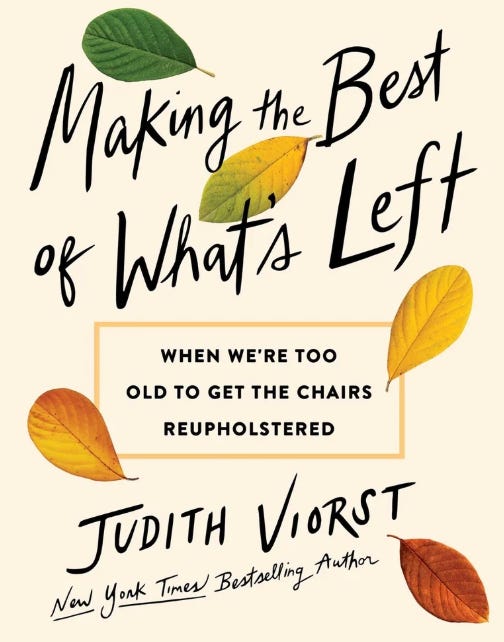
I am not yet ready to read this book but perhaps you are. And I know that sooner or later, I will not only be ready, but will probably need it.
Do you have a book you are saving right now for when you are ready?
Welcome New Subscribers!
If you’ve just subscribed, thank you so much for being here. If you would like to check out past issues, here’s a quick link to the archives. Be sure to check out our Resources for Readers and Writers too where you will find links for readers, book clubs, writers, and writing groups. And if you’d like to browse for your next read, don’t forget to check out books by authors in our community at the Spark Author Page. If you are a published author, we’d love to share you and your work. Click here for more info. Another great source: the many wonderful reviews you’ll find among the #Bookstackers.
The more the merrier! Please share with your friends and invite them to join us!
Ways to show you like what’s happening here
We don’t do paywalls but we do work hard so if you’d like to show your support for Spark, consider a paid subscription ($5/month or $35/year) or use this as a link that will allow single contributions of any amount via PayPal.
There will be no paywalls. All subscribers will still have access to every post, archives, comments section, etc. If finances are an issue (and when are they not?), you can still show your support for Spark by participating in our conversations, “liking” a post by hitting that heart, and by sharing Spark among your friends. All of these things help bring new subscribers into the fold and every time we expand our audience, the conversation grows and deepens. Click below for more info.
That’s it for now. Let me know how you are and what you’re reading. If there’s an idea, book, or question you’d like to see in an upcoming issue of Spark, let us know! Use the comment button below or just hit reply to this email and send your message directly.
And remember, If you like what you see or it resonates with you, please take a minute to click the heart ❤️ below - it helps more folks to find us!
Ciao for now!
Gratefully yours,
Betsy
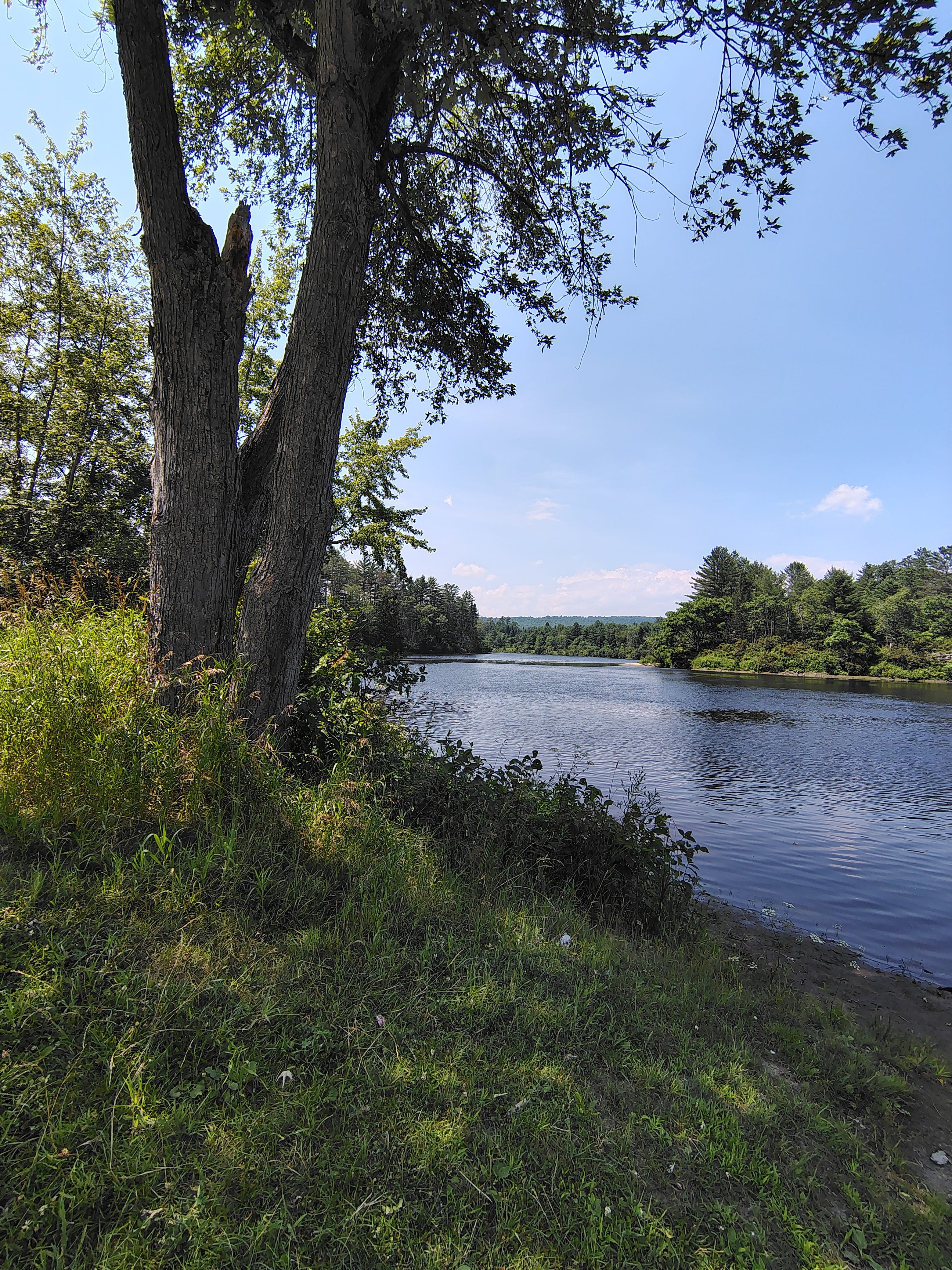
P.S. And now, your moment of Zen…healing sky, calm waters
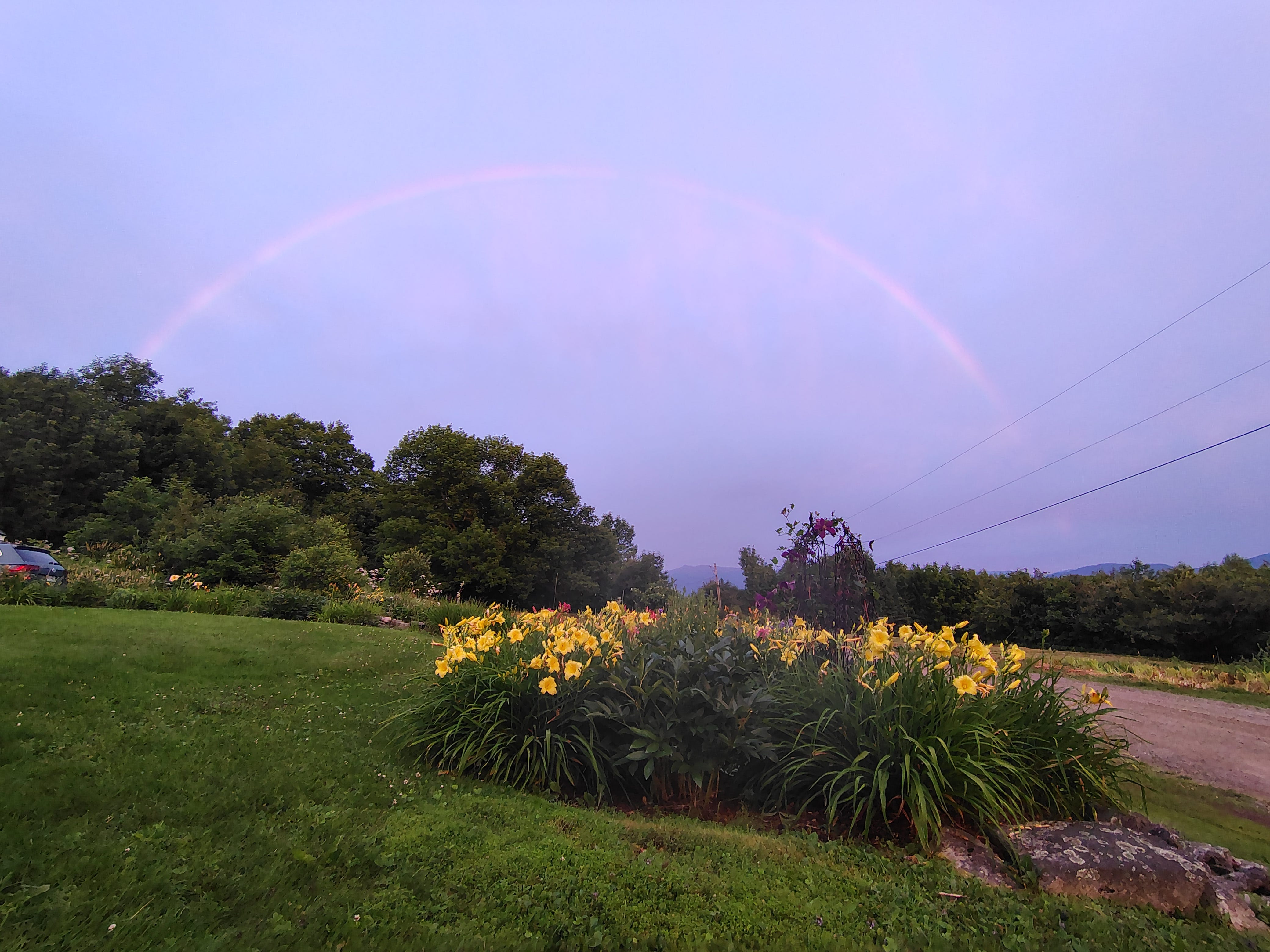
I have very few photos from my recent trip. I missed snapping the blue heron that sliced across a flaming sky over the Atlantic while I sipped a cool drink with my friend on her deck. I missed the chance to snap a photo of me with a another friend I’ve known since I was ten years old. I did manage to grab these though, and they remind me that gifts arrive when I least expect them — a faint but perfectly-formed rainbow near the end of a long hot day of saying goodbye, or unexpectedly rounding the corner on a road I’ve traveled for years and finding a bit of peace in the sky and water of of John’s River near Dalton, NH.
Calling for Your Contribution to “Moment of Zen”
What is YOUR moment of Zen? Send me your photos, a video, a drawing, a song, a poem, or anything with a visual that moved you, thrilled you, calmed you. Or just cracked you up. This feature is wide open for your own personal interpretation.
Come on, go through your photos, your memories or just keep your eyes and ears to the ground and then share. Send your photos/links, etc. to me by replying to this email or simply by sending to: elizabethmarro@substack.com. The main guidelines are probably already obvious: don’t hurt anyone -- don’t send anything that violates the privacy of someone you love or even someone you hate, don’t send anything divisive, or aimed at disparaging others. Our Zen moments are to help us connect, to bond, to learn, to wonder, to share -- to escape the world for a little bit and return refreshed.
I can’t wait to see what you send!
And remember, If you like what you see or it resonates with you, please take a minute to click the heart ❤️ below - it helps more folks to find us!
Lately I am realizing that some of the decades long sadnesses have somehow transmogrified into comfortable memories, or maybe it's that the memories have fused with sadness that I really feel anymore. I'm still not saying it well. I can tell that I could keep the memory without the valence of grief if I dared. I was recently reminded of a friend who died 25 years ago and I wanted to badly to remember the fun times we had, but I could only remember the loss. Somehow there has to be a way around grief functioning as a kind of thumbtack for important memories, you know?
LOSS; I'm still trying to figure it out.